UW Tacoma / May 2025
IbuiltthelargesthackathonsouthofSeattle.
UWT hadn't hosted a hackathon since 2019 and had never run two years in a row. I changed that — organizing a 100+ competitor event on just $3,500 in funding that became the largest hackathon south of Seattle. Another hackathon ran with $35,000 in funding — we were still twice their size.
Event Organizer & Founder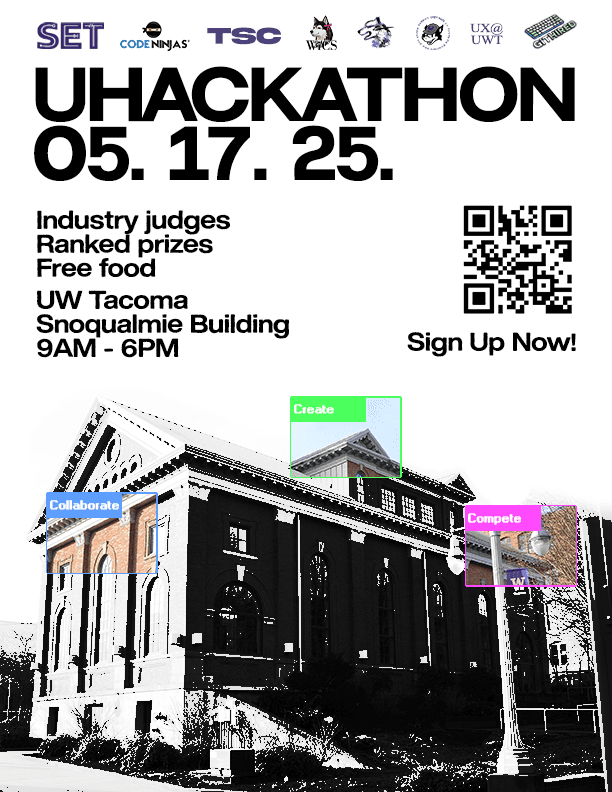
Competitors
Largest hackathon south of Seattle — on just $3,500 in funding
Partner Clubs
Tech Startup Club, Game Dev Club, WiCS, UX@UWT, GitHired, GreyHat, and Huscii
Build Time
Teams went from idea to working prototype in a single day
Industry Judges
Panel of professionals from industry and academia
01 / The Challenge
No hackathon culture, no precedent, no playbook
The region south of Seattle — spanning Tacoma, Olympia, Puyallup, and surrounding areas — had only hosted a single hackathon in years, and no event in the region had ever surpassed 70 competitors. UW Tacoma's last hackathon was in 2019, and the university had never managed to host two in consecutive years. I wanted to change that — not just with a one-off event, but by building something sustainable.
No hackathon culture
UWT's last hackathon was in 2019, and the school had never hosted two years in a row. There was no playbook, no infrastructure, and no precedent.
Regional dead zone
The entire region south of Seattle — Tacoma, Olympia, Puyallup, and surrounding areas — had seen only 1 hackathon in years, and none had ever surpassed 70 competitors.
Cross-org coordination
Pulling off a 100+ person event required aligning seven student clubs, university administration, three sponsors, nine judges, and volunteers — all with different timelines and priorities.
First-timer accessibility
Many students had never been to a hackathon. The event needed to be welcoming to beginners while still challenging experienced hackers.
02 / Execution
Seven clubs, nine judges, one hundred competitors
I partnered with Kylie Hammett, Alex Douk, and Eva Howard to bring together seven student organizations, secure sponsorship from SET, Code Ninjas, and Insights Emerge, and build an event that welcomed both first-timers and experienced hackers.
9–10 AM
Kickoff
10 AM–4 PM
Build
12 PM
Lunch
4–6 PM
Judging
Multi-Club Coalition
United seven clubs — Tech Startup Club, Game Dev Club, WiCS, UX@UWT, GitHired, GreyHat, and Huscii — combining each club's reach and expertise to build something none could do alone.
Sponsor & Judge Pipeline
Secured sponsorship from UW Tacoma's School of Engineering & Technology (SET), Code Ninjas, and Insights Emerge. Recruited a panel of 9 industry and academic judges.
Day-Of Operations
Ran a tight 9-hour schedule: team formation & kickoff, 6 hours of coding, catered lunch & networking, then project presentations and judging.
Sustainability Plan
Built documentation, processes, and club partnerships to ensure UHackathon runs for at least two more years — breaking UWT's streak of one-off events.
03 / Winners
From idea to prototype in six hours
AI-pplicant
Murad Tair, Gregory Y, Anthony Crow-Jones
An AI-powered mock interview tool that simulates behavioral and technical interviews with a hiring manager, providing real-time feedback and follow-up questions.
UHealth
Nicholas Jordan, Jacob Klymenko, Anthony Naydyuk, Primitivo Bambao IV
A deep learning diagnostic tool using a Convolutional Neural Network (CNN) to predict pneumonia from chest x-rays at 90% accuracy, with an AI chatbot for diagnosis follow-up.
04 / Innovation Spotlight
UHealth — deep learning meets diagnostics
Built by Nicholas Jordan, Jacob Klymenko, Anthony Naydyuk, and Primitivo Bambao IV — current and former officers of my club — UHealth showed what's possible when you give talented people six hours and a real problem to solve.
What They Built
CNN Diagnostic Model
A Convolutional Neural Network trained to predict pneumonia from chest x-rays at 90% accuracy — built and trained within a 6-hour window.
Live Image Upload
Users upload chest x-ray images directly to the app for real-time predictions from the trained model.
Medical Chatbot
An AI-powered chatbot helps users understand their diagnosis, ask follow-up questions, and learn about next steps.
The Hackathon Pivot
The team originally planned a model with 14 classification labels, but hardware limitations and the 6-hour constraint forced a pivot to binary classification. Rather than shipping something broken, they scoped down and delivered a polished, working product — the kind of tradeoff real engineers make every day.
Where It Could Go
- →Highlight exact x-ray features that indicate pneumonia
- →Expand beyond binary to multi-condition classification
- →Build a full diagnostic support platform for doctors
- →Push accuracy above 95% with data augmentation techniques
05 / Impact
The start of a new era in Tacoma
UHackathon didn't just break the regional record — it proved that Tacoma's tech community is ready for more. With documentation, partnerships, and momentum in place, the event is set to run annually for years to come.
Record-Breaking
- •100+ competitors
- •Largest south of Seattle
- •2x bigger on 10x less funding
- •Surpassed 70-person regional cap
Community Built
- •7 clubs united
- •9 industry judges
- •SET, Code Ninjas & Insights Emerge
- •Volunteers & planning team
Built to Last
- •Set up for 2+ more years
- •Breaking one-off event cycle
- •Documentation & processes
- •Club partnership framework
“We will be repaid in the joy and opportunity we've created for others.